

STELAR Piloting Activities Wrap-Up: Advancing Food Risk Prevention with AI-Powered Tools
The Horizon Europe project STELAR, a three-year innovation action, is finishing this August after advancing the way data is used to strengthen safety and transparency in the agrifood sector.
Bringing together recognisable academic and industry partners across Europe, the project has tested its results through three pilots in real-world settings. Among them, Pilot A, led by AGROKNOW in Greece, focused on food risk prevention, showing how artificial intelligence and automation can support faster, more reliable decision-making in food supply chains.
Key Success: Turning Complex Data into Actionable Insights
Pilot A integrated several tools developed within STELAR into AGROKNOW’s proprietary FOODAKAI platform, a food safety intelligence solution used by companies and authorities worldwide. This integration allowed the platform to demonstrate how fragmented, high-volume data can be converted into early warnings and practical guidance for risk prevention.
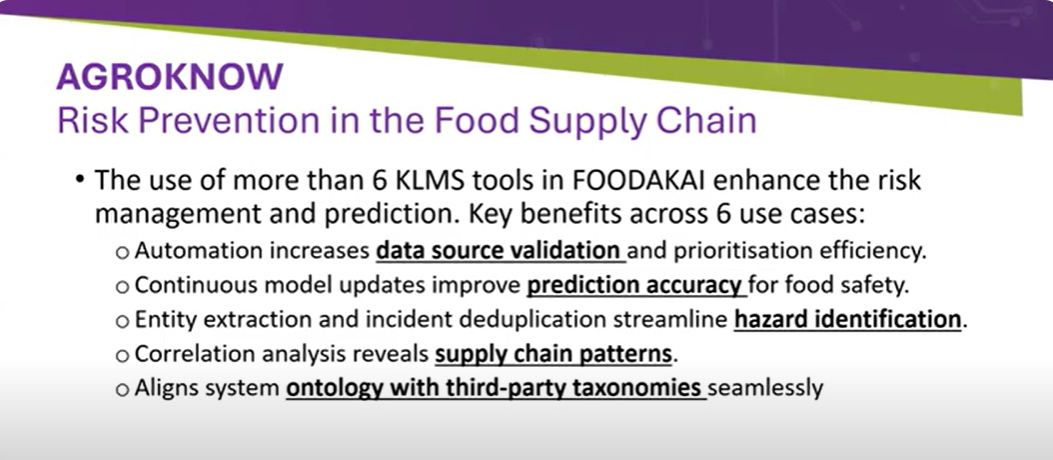
The pilot tackled challenges that are central to modern food safety management: extracting information from incident reports using natural language processing, removing duplicate alerts to clarify insights, running correlation analysis across multiple time series, and aligning diverse data schemas with internal taxonomies.
A large-scale effort also applied large language models to ingredient mapping, covering more than 6,800 client ingredients, 15,400 FOODAKAI ingredients, nearly one million suppliers, and over 2,500 hazards. The scale of this exercise highlighted the importance of automation in making food safety intelligence usable and efficient.
“Food safety management is about timeliness, precision, and trust. By integrating STELAR tools into our FOODAKAI platform, we are showing how advanced AI methods can reduce risks and improve confidence in supply chains,” said Charalampos Thanopoulos, Head of R&D at AGROKNOW.
Applications and Outcomes
The outcomes of Pilot A showed how AI-powered intelligence can support day-to-day food safety operations. Among the demonstrated applications were:
- Automated risk assessments
- Harmonised data for procurement and compliance
- Improved traceability
- Regulatory reporting support
- The development of AI-driven food safety assistants.
Together, these innovations enable faster, better-informed decisions while reducing the margin of human error – an essential step toward safer and more transparent food systems.
Next Steps: Scaling Impact Across the Agrifood Sector
As STELAR concludes, the project is preparing for wider impact beyond its pilots. Planned actions include engaging policymakers in discussions on data transparency and interoperability, refining tools through ongoing user feedback, and strengthening open-source collaborations to broaden adoption. Future efforts will also explore integration with emerging AI technologies, ensuring that the methods developed remain relevant and scalable across diverse agrifood contexts.
Collaborating Partners
Pilot A was led by AGROKNOW in Greece, with contributions from Athena Research Center, Eindhoven University of Technology (TU/e), Universität der Bundeswehr München (UniBwM), and Foodscale Hub (FSH). Along with the rest of the project consortium, the organisations demonstrated how European research collaboration can deliver practical, real-world benefits for food safety and supply chain resilience.
For more information on STELAR pilots and final results, visit STELAR website and LinkedIn.

